Thank you to all those who followed this blog during the pilgrimage to the Holy Land and afterwards for our newspaper coverage and the columns by Archbishop Tobin!
Though there will be no more future posts, this blog will remain archived permanently for all who wish to browse through its contents--keep in mind that the posts are in reverse chronological order, so to rewind to the beginning of the pilgrimage go to the last post.
Thursday, April 2, 2015

Final Columns by Archbishop Tobin
Here are the final two Lenten/Easter Columns in which Archbishop Tobin discusses the pilgrimage to the Holy Land:
Wednesday, March 18, 2015
Life for Catholics in Holy Land involves persecution and economic hardship

GALILEE and JERUSALEM REGIONS OF ISRAEL—The Azraq family roots dig deep into the soil of Old City Jerusalem.Read the rest of the story here
“Our house is about 300 years old,” says Anton “Tony” Azraq, 39, a Melkite Catholic who has lived in Old City Jerusalem his whole life. “It’s built on top of a previous structure that goes back to the 12th century, to the Crusader time.”
His family name, which means “blue” in Arabic, goes back much further, to the seventh century when Muslims invaded the Holy Land and made Christians wear blue belts for easy identification.
But such deep Christian roots are at the risk of being severed in the Holy Land. Wars, laws, a poor economy and the high cost of living are driving Christians from the land where Christ began the Church.
This story looks at life in the Holy Land through the eyes of two Catholic Christians—Azraq, who served as tour guide for the archdiocesan pilgrimage, and Alfred Ra’ad, a shop owner in Old City Jerusalem.
Related: Tour guide gives pilgrims cultural, historical and archaeological insight on Scripture
More Columns from Archbishop Tobin
The latest columns from Archbishop Joseph W. Tobin that refer to the Holy Land pilgrimage:
Thursday, March 12, 2015
How Catholics in central and southern Indiana can help keep a Christian presence in the Holy Land

After 11 days on the archdiocesan pilgrimage to the Holy Land, I believe that were it not for the presence of the Franciscan order as pilgrimage site custodians, the Christian presence would all but evaporate from the region.Read the rest of the story here
For centuries, the Franciscans have maintained the properties of numerous shrines, chapels and churches in the Holy Land, making them available for pilgrims to visit for veneration, prayer and spiritual renewal.
So what can we in central and southern Indiana do about the situation for our brother and sister Christians in the Holy Land?
A land of calm and chaos: Holy Land pilgrimage observations

The sky was clear as we sat in the wooden boat that plied the waters of the Sea of Galilee. I inhaled deeply then exhaled slowly, taking in the view.Read the rest of this story
To the east and the north, green hills continued their watch as they did in the time of Christ. To the west, the mountains of Jordan seemed to slumber in a shroud of mist.
Such a peaceful feeling it was, riding upon the lake in the early morning quiet.
Yet thanks to the small size of the “sea” (33 miles long by 13 miles wide), its shallow depth and its location between two mountain ranges which trap weather systems, a storm on that same placid lake can create waves as high as 12 feet, large enough to swamp the Apostles’ boat and cause them to cry out, “Lord, save us!” (Mt 8:25)
That contrast of calm and chaos on the Sea of Galilee is an apt analogy to describe the Holy Land in general.
It is a land where views like the deep blue of the Mediterranean Sea and the lush vista from Mount Tabor can produce such serenity, yet where religious, ethnic and political differences create a palpable tension that seems ready to combust at any moment.
One simply can’t walk away from a pilgrimage to the Holy Land without spiritual growth.
Thursday, March 5, 2015
Reflection: A perfect pilgrimage to the Holy Land
Daniel Conway writes:
Read the whole reflection here
(Natalie Hoefer will also be submitting news stories in the coming weeks regarding the pilgrimage; they will be posted here as the final items for the blog)
The next time the Archdiocese of Indianapolis advertises a pilgrimage to the Holy Land, don’t hesitate. Don’t think about it, discuss it with family and friends, or pray about it at length. Say a quick prayer to the Holy Spirit and sign up—right away! If you delay, all the slots will be filled, and you’ll miss out on a perfect pilgrimage experience.
Don’t just take my word for it. Ask any of the diverse group of 50 people who accompanied Indianapolis Archbishop Joseph W. Tobin to the Holy Land last month. They’ll tell you that it was an awesome, inspiring, joyful, sometimes exhausting but always uplifting spiritual journey. In short, a perfect pilgrimage.
Nothing is perfect that involves sinful human beings. True enough. From a human perspective there were the minor irritations of international travel—but no flight delays or other interruptions.
And there was the anxiety caused by “civil unrest” in the region—but we experienced no difficulties as a result. Occasionally, strangers occupying close quarters on the bus or in the crowded spaces visited throughout the Holy Land can rub each other the wrong way. True enough, but this is all part of the perfect pilgrimage experience!
What makes a pilgrimage “perfect”?
Read the whole reflection here
(Natalie Hoefer will also be submitting news stories in the coming weeks regarding the pilgrimage; they will be posted here as the final items for the blog)
Wednesday, March 4, 2015
More Reflections on Lent and the Holy Land from Archbishop Tobin
From Archbishop Tobin's weekly column:
- Lent is a time to cast off indifference (February 27, 2015)
- Spend some quiet time in God’s closeness this Lenten season (March 6, 2015)
Wednesday, February 25, 2015
Photo DVD Available for Purchase
During the course of the pilgrimage to the Holy Land, Criterion reporter Natalie Hoefer took photos to document the trip. Many were featured on this blog.
Natalie sorted through them and we are offering a DVD disc of more than 1,000 photos from the pilgrimage for purchase. The disc is $10; once you have it you are free to reprint any of the photos (either at home or at a store, such as Walgreen's) for personal use.

Natalie sorted through them and we are offering a DVD disc of more than 1,000 photos from the pilgrimage for purchase. The disc is $10; once you have it you are free to reprint any of the photos (either at home or at a store, such as Walgreen's) for personal use.
Click here to go to our secure purchasing site
* Please note that this is a DVD and you must have a DVD drive on your computer to use it; it will not work on a CD drive nor will it work on a DVD player on your television.
Thursday, February 19, 2015
Photo CD to be Made Available
For those who went on the pilgrimage to the Holy Land, as well as those who followed it online or are otherwise interested, a photo CD containing the full-size photographs taken by our reporter, Natalie Hoefer, will be available for purchase in the near future.
Those who order one will then be free to re-print the photos where ever they wish to, or keep them digitally to share with family and friends.
Check back here next week for more information!
Those who order one will then be free to re-print the photos where ever they wish to, or keep them digitally to share with family and friends.
Check back here next week for more information!
Archbishop Tobin on the Pilgrimage
This week, Archbishop Tobin writes a bit about the pilgrimage to the Holy Land in his weekly column:
"Earlier this week, I returned from a 12-day pilgrimage to the Holy Land. I can’t imagine a better way to prepare for the spiritual journey that is Lent. To be actually present in the land of Jesus, to pray where he prayed, and to experience firsthand all the holy places that the Gospels speak about so powerfully, is an experience that I wish every Christian could have.Read the whole column here (also available in Spanish)
"My fellow pilgrims and I were very conscious of the fact that we traveled to the Holy Land on behalf of all the people of our archdiocese, the Church in central and southern Indiana. We prayed for you, and we brought you with us (in spirit) every time we visited one of the Holy Land’s remarkable sacred spaces.
"Pilgrimages are as old as Judaism and Christianity (and many other religious traditions). St. Luke tells us that the Holy Family (Jesus, Mary and Joseph) made an annual pilgrimage from Nazareth to Jerusalem in observance of the Feast of the Passover."
Tuesday, February 17, 2015
Columns on the Holy Land from John Fink
The editor emeritus of The Criterion, John Fink, has started a new series of weekly columns about the Holy Land.
Click below to read the first three installments of his column:
Click below to read the first three installments of his column:
Sunday, February 15, 2015
Day Twelve -- Itinerary and Prayer Intention
Today's Itinerary: "Today our Holy Land pilgrimage comes to an end as we transfer to the airport in Tel Aviv to catch our return flight home."
Today's Prayer Intention: For safe travel for the pilgrims and for all travelers.
(Be sure to check back with this blog later in the week for any additional content receive after the pilgrims settle home)
Today's Prayer Intention: For safe travel for the pilgrims and for all travelers.
(Be sure to check back with this blog later in the week for any additional content receive after the pilgrims settle home)
Saturday, February 14, 2015
Day Eleven -- Updates and Photos
By Natalie Hoefer
 JERUSALEM— In the dark of the morning, at 5 a.m., the pilgrims walked through the quiet, empty streets of the Christian quarter of Jerusalem for Mass at the tomb of the Holy Sepulcher. (See a photo gallery from the pilgrims' day)
Archbishop Joseph W. Tobin chose to begin Mass in the chapel of the tomb of Christ’s burial with words appropriate to the occasion.
“Normally we say the entrance antiphon, but I just thought the one for Easter was just very appropriate: ‘Early in the morning they came to the sepulcher at sunrise, alleluia,’ ” he explained. “That’s what we did, and we found it empty.”
The sanctuary of the chapel over the tomb consists of a small circular room in which about 25 people can stand, followed by a short archway leading to the even smaller section where Mass is celebrated. In that smaller sanctuary, built directly above what early Christians revered as the tomb of Christ, is a slab of stone. Immediately under that slab is the stone shelf on which the body of Christ was believed to have rested in the tomb.
As the half-hour Mass was celebrated, one by one the pilgrims bent low through the arch and touched the stone.
“The four gospels agree on one detail of the Lord’s resurrection—that no one saw him rise,” the archbishop said in his homily. “In that sense we stand shoulder to shoulder with Mary of Magdala and Peter and John. All they found was an empty tomb, and we come this morning and find this empty tomb, which is God’s answer to human suffering, to human sin, to human mortality—an empty tomb.
“Like Peter, we look and we believe, and we thank God that we share that was illuminated here. All we can do is thank God and live as children of the light.”
 The Mass left many pilgrims at a loss for the right words to capture their emotions.
“It’s almost overwhelming to think we were at the place where Jesus was buried,” said Joni Greulich of St. Simon Parish in Indianapolis. “I’ll never look at Easter the same again.”
Sharon Rushing of St. Michael the Archangel Parish in Olympia, Wash., appreciated the hushed, reverent tone of the early Mass.
“I’m so glad we were there early, because we had the quiet,” she said. “It just seemed right. It was a short time, but it was the right time, not in the hubbub of everything.”
Larry Dougherty of Immaculate Heart of Mary Parish found himself focusing on the fact that the tomb is empty.
“It was a special place, but what I was thinking was, ‘He’s resurrected. He’s not here. He’s gone,’ ” Dougherty said. “But it’s still a holy place.”
Later in the day, the archbishop reflected on his experience celebrating Mass at the site of Christ’s burial and resurrection.
 “It’s hard to describe,” he admitted. “The word awesome is overworked these days, but that was really a feeling of being in awe, standing there. Knowing that the mysteries we were celebrating on that altar were the mysteries of the cross and the empty tomb.”
As he reflected upon the pilgrimage, Archbishop Tobin said he was “very conscious of carrying the archdiocese with me. Whenever I prayed, I prayed in a special way for the archdiocese.
“I also kind of sensed from past pilgrimages that we would come together as a community, and that would be one of the great consequences of the pilgrimage, and that has certainly happened,” he said.
Likewise, many pilgrims felt an admiration for the archbishop.
“The whole pilgrimage, we were witnesses to the archbishop, and Father Joe [Newton], too, as our leader and servant, both leading and serving us,” said Sheila Sterrett of St. Lawrence Parish in Indianapolis. “I think it strengthens our kindness toward each other to see that in our leaders. I think that added a lot to the pilgrimage.”
See a photo gallery from Day Eleven of the pilgrimage
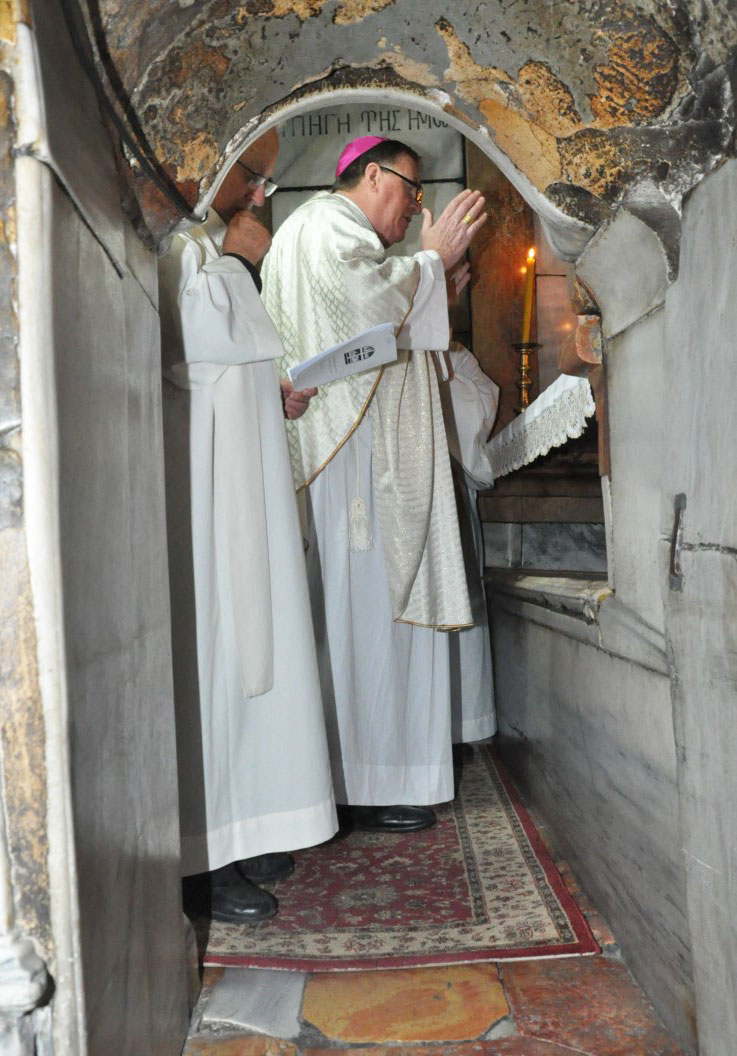
Archbishop Joseph W. Tobin chose to begin Mass in the chapel of the tomb of Christ’s burial with words appropriate to the occasion.
“Normally we say the entrance antiphon, but I just thought the one for Easter was just very appropriate: ‘Early in the morning they came to the sepulcher at sunrise, alleluia,’ ” he explained. “That’s what we did, and we found it empty.”
The sanctuary of the chapel over the tomb consists of a small circular room in which about 25 people can stand, followed by a short archway leading to the even smaller section where Mass is celebrated. In that smaller sanctuary, built directly above what early Christians revered as the tomb of Christ, is a slab of stone. Immediately under that slab is the stone shelf on which the body of Christ was believed to have rested in the tomb.
As the half-hour Mass was celebrated, one by one the pilgrims bent low through the arch and touched the stone.
“The four gospels agree on one detail of the Lord’s resurrection—that no one saw him rise,” the archbishop said in his homily. “In that sense we stand shoulder to shoulder with Mary of Magdala and Peter and John. All they found was an empty tomb, and we come this morning and find this empty tomb, which is God’s answer to human suffering, to human sin, to human mortality—an empty tomb.
“Like Peter, we look and we believe, and we thank God that we share that was illuminated here. All we can do is thank God and live as children of the light.”
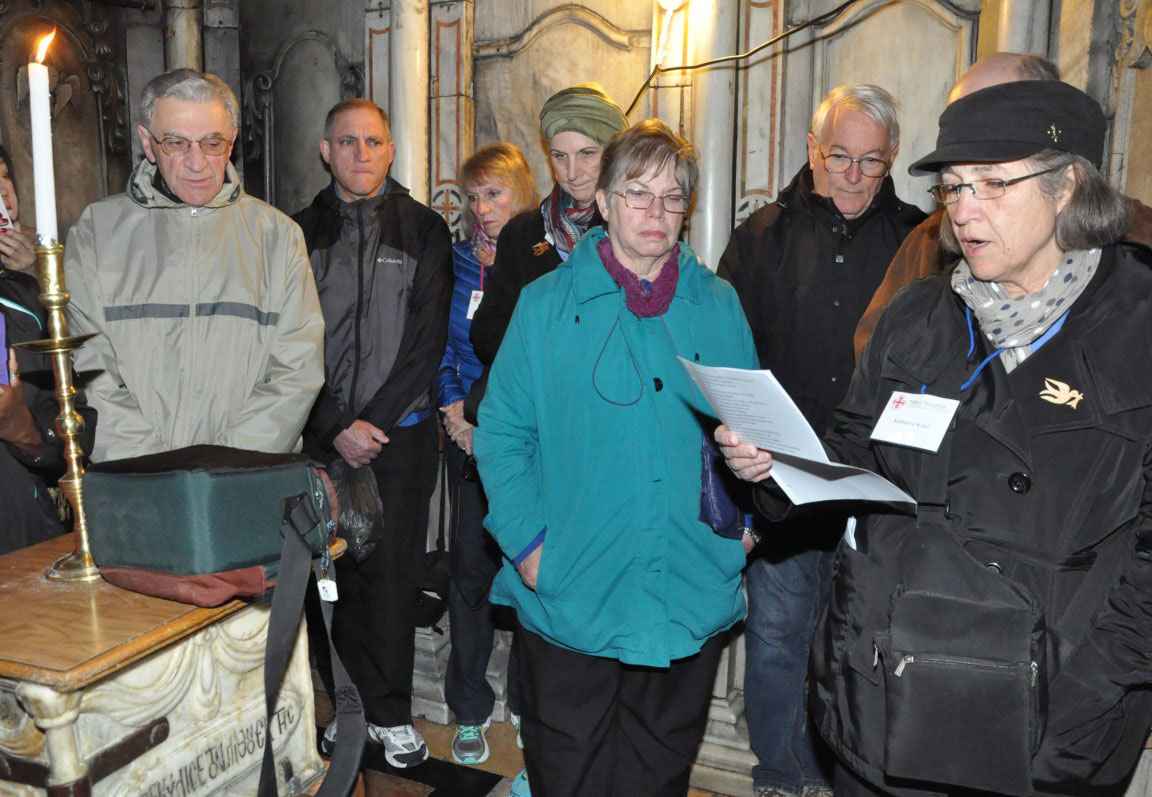 The Mass left many pilgrims at a loss for the right words to capture their emotions.
“It’s almost overwhelming to think we were at the place where Jesus was buried,” said Joni Greulich of St. Simon Parish in Indianapolis. “I’ll never look at Easter the same again.”
Sharon Rushing of St. Michael the Archangel Parish in Olympia, Wash., appreciated the hushed, reverent tone of the early Mass.
“I’m so glad we were there early, because we had the quiet,” she said. “It just seemed right. It was a short time, but it was the right time, not in the hubbub of everything.”
Larry Dougherty of Immaculate Heart of Mary Parish found himself focusing on the fact that the tomb is empty.
“It was a special place, but what I was thinking was, ‘He’s resurrected. He’s not here. He’s gone,’ ” Dougherty said. “But it’s still a holy place.”
Later in the day, the archbishop reflected on his experience celebrating Mass at the site of Christ’s burial and resurrection.
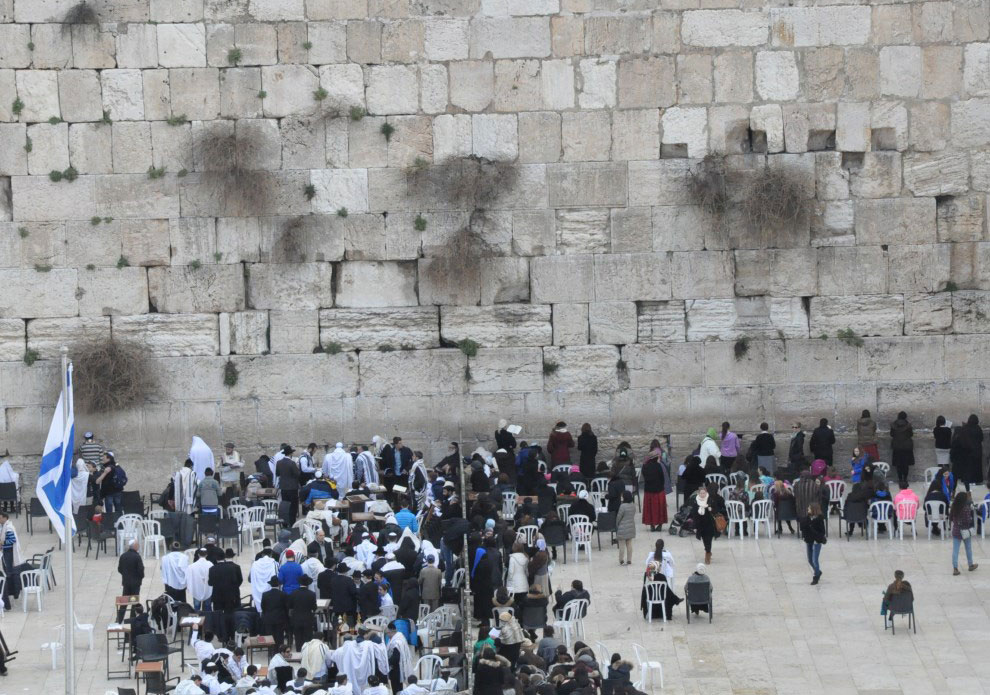
As he reflected upon the pilgrimage, Archbishop Tobin said he was “very conscious of carrying the archdiocese with me. Whenever I prayed, I prayed in a special way for the archdiocese.
“I also kind of sensed from past pilgrimages that we would come together as a community, and that would be one of the great consequences of the pilgrimage, and that has certainly happened,” he said.
Likewise, many pilgrims felt an admiration for the archbishop.
“The whole pilgrimage, we were witnesses to the archbishop, and Father Joe [Newton], too, as our leader and servant, both leading and serving us,” said Sheila Sterrett of St. Lawrence Parish in Indianapolis. “I think it strengthens our kindness toward each other to see that in our leaders. I think that added a lot to the pilgrimage.”
See a photo gallery from Day Eleven of the pilgrimage
Day Eleven -- Itinerary and Prayer Intention
Today's Itinerary: "This morning we will celebrate an early morning Mass at the Tomb of our Lord. After Mass, we will spend some private time in prayer and reflection at the Church of the Holy Sepulchre before returning to our hotel for breakfast. The remainder of the day is free for personal prayer and exploring the Old City."
Today's Prayer Intention: For all the faithful departed.
Today's Prayer Intention: For all the faithful departed.
Friday, February 13, 2015
Day Ten -- Updates and Photos
By Natalie Hoefer
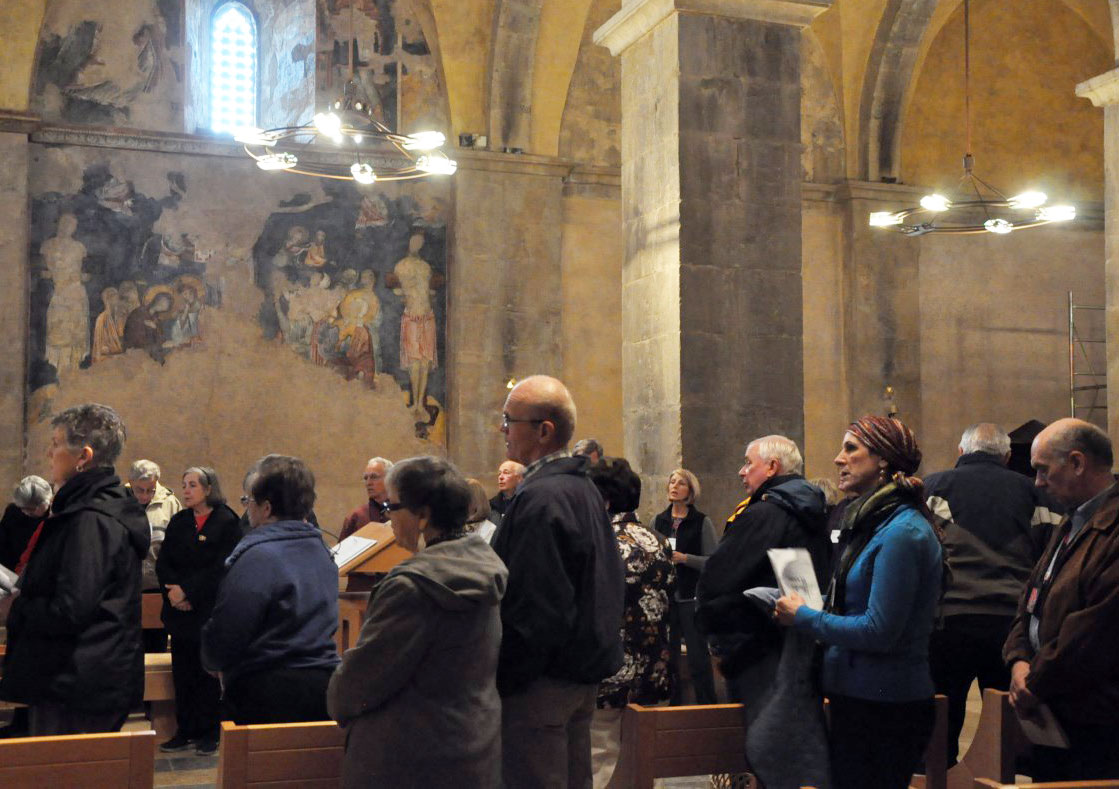
 ABU GOSH and EIN KAREM—Ghostly, faceless figures adorned the stone walls of the 12th century Church of the Resurrection in Abu Gosh, called Emmaus in Jesus’ time. The faces were wiped away by Muslims centuries before.
The towering walls echoed with Archbishop Joseph W. Tobin’s voice as he delivered a homily on the Emmaus story in Luke 24.
“I believe it is not a coincidence that we’re here, listening to that Gospel on the second to last full day of our pilgrimage,” he said. “I don’t think it would have had the same impact on us if we’d heard it on the first day.” (See a photo gallery from the pilgrims' day)
He spoke of the parallel between the disciples’ journey to Emmaus and that of the members of the archdiocesan pilgrimage to the Holy Land. The archbishop noted how Jesus first broke open the Scripture for the disheartened disciples on their journey to Emmaus from Jerusalem, and how “it all came together for them in the breaking of the bread.”
The 12th century church was built by Crusaders on top of the remains of several destroyed Christian churches dating back to the 3rd century. The church is built over water flowing from a nearby spring. Tradition holds that Jesus and the disciples would have washed their feet in the stream before eating their supper.
The highlight of the day for Mike and Audrey Kostrzewa of SS. Peter and Paul Cathedral in Indianapolis occurred during the Mass in the church.
“We got to renew our vows like the others did in Cana,” said Mike. “We weren’t able to do it that day, so we did it today in Emmaus. That was really special.” The couple has been married for almost 42 years.
 “The setting was perfect,” said Audrey, who felt “honored” to serve as cantor during the Mass. “It was a gorgeous church—it was a privilege to be there.”
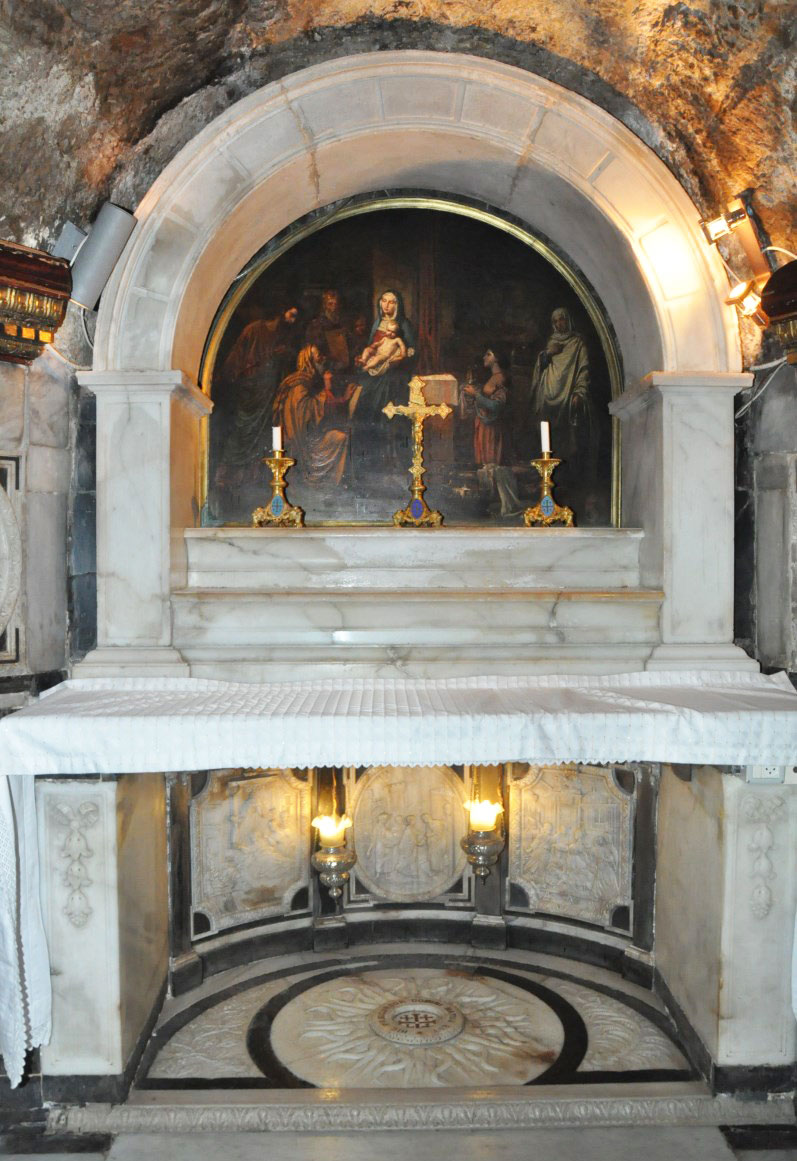
The couple joined several other pilgrims on what Mike called “quite a hike” up to the Church of the Visitation in Ein Karem, the town where Mary visited her cousin Elizabeth upon hearing the older woman was expecting. It lies high on a mountainside about 4.5 miles west of Jerusalem.
Tony Azraq, the pilgrimage tour guide who is an archaeologist and professor, said the site is traditional rather than authentic. A Benedictine monastery and convent are located on the site.
The Magnificat—the prayer the Blessed Mother exclaimed upon Elizabeth’s greeting—is written in tiles in several languages on the walls of the church’s courtyard.
The pilgrims also walked through a light rain to the nearby church marking the traditional birthplace of St. John the Baptist. In the grotto of a cave below and to the side of the main altar, several pilgrims knelt to touch the place where it is believed the son of Elizabeth and Zechariah was born.
Joann Pierotti of Sacred Heart Parish in Wanatah, Ind., in the Diocese of Gary, was impressed by all the churches the pilgrims visited today.
 “Today was all so inspiring,” she said. “Most inspiring was just going into the churches, sitting and meditating. They’re all so beautiful . I’m so thankful I was able to come.”
Pierotti heard about the pilgrimage through a friend. It was her first time to the Holy Land, and her first time to meet and spend time with Archbishop Tobin.
“His homilies are just amazing,” she said. “You try to catch every word and hang on. He connected his homily of the day with our travels of that day, and pulled it together so beautifully.”
“And he’s such a down-to-earth man. You feel comfortable with him. He’s just one of the group. You didn’t feel he put himself above anyone else.”
Despite living in the Diocese of Gary in northwestern Indiana, Pierotti believes she will see Archbishop Tobin in the future—“wearing red.”
“I think he’ll be a cardinal in the not too distant future,” she said. “I think he was born for it.”
See a photo gallery from Day Ten of the pilgrimage
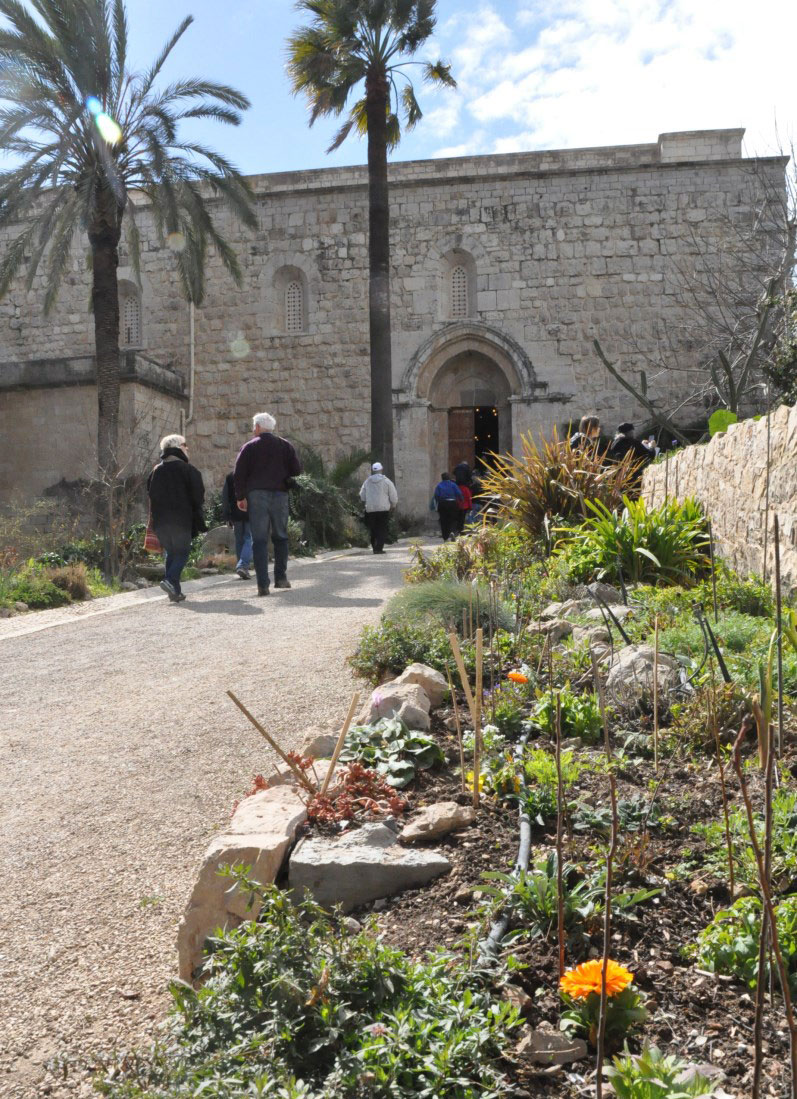
The towering walls echoed with Archbishop Joseph W. Tobin’s voice as he delivered a homily on the Emmaus story in Luke 24.
“I believe it is not a coincidence that we’re here, listening to that Gospel on the second to last full day of our pilgrimage,” he said. “I don’t think it would have had the same impact on us if we’d heard it on the first day.” (See a photo gallery from the pilgrims' day)
He spoke of the parallel between the disciples’ journey to Emmaus and that of the members of the archdiocesan pilgrimage to the Holy Land. The archbishop noted how Jesus first broke open the Scripture for the disheartened disciples on their journey to Emmaus from Jerusalem, and how “it all came together for them in the breaking of the bread.”
The 12th century church was built by Crusaders on top of the remains of several destroyed Christian churches dating back to the 3rd century. The church is built over water flowing from a nearby spring. Tradition holds that Jesus and the disciples would have washed their feet in the stream before eating their supper.
The highlight of the day for Mike and Audrey Kostrzewa of SS. Peter and Paul Cathedral in Indianapolis occurred during the Mass in the church.
“We got to renew our vows like the others did in Cana,” said Mike. “We weren’t able to do it that day, so we did it today in Emmaus. That was really special.” The couple has been married for almost 42 years.
The couple joined several other pilgrims on what Mike called “quite a hike” up to the Church of the Visitation in Ein Karem, the town where Mary visited her cousin Elizabeth upon hearing the older woman was expecting. It lies high on a mountainside about 4.5 miles west of Jerusalem.
Tony Azraq, the pilgrimage tour guide who is an archaeologist and professor, said the site is traditional rather than authentic. A Benedictine monastery and convent are located on the site.
The Magnificat—the prayer the Blessed Mother exclaimed upon Elizabeth’s greeting—is written in tiles in several languages on the walls of the church’s courtyard.
The pilgrims also walked through a light rain to the nearby church marking the traditional birthplace of St. John the Baptist. In the grotto of a cave below and to the side of the main altar, several pilgrims knelt to touch the place where it is believed the son of Elizabeth and Zechariah was born.
Joann Pierotti of Sacred Heart Parish in Wanatah, Ind., in the Diocese of Gary, was impressed by all the churches the pilgrims visited today.
Pierotti heard about the pilgrimage through a friend. It was her first time to the Holy Land, and her first time to meet and spend time with Archbishop Tobin.
“His homilies are just amazing,” she said. “You try to catch every word and hang on. He connected his homily of the day with our travels of that day, and pulled it together so beautifully.”
“And he’s such a down-to-earth man. You feel comfortable with him. He’s just one of the group. You didn’t feel he put himself above anyone else.”
Despite living in the Diocese of Gary in northwestern Indiana, Pierotti believes she will see Archbishop Tobin in the future—“wearing red.”
“I think he’ll be a cardinal in the not too distant future,” she said. “I think he was born for it.”
See a photo gallery from Day Ten of the pilgrimage
Day Ten -- Itinerary and Prayer Intention
Today's Itinerary: "This morning we will drive Abu Ghosh (Emmaus) where Jesus appeared following His resurrection. After Mass we will return to Jerusalem and go to Mount Zion and visit the Upper Room, the site where Jesus celebrated the Last Supper. We will then pray the Rosary together int he Church of Dormition, where Mary was assumed into heaven. Our final stop of hte day will be at the Church of St. Peter in Gallicantu where Peter denied Jesus three times."
Today's Prayer Intention: For the young adults of the archdiocese.
Today's Prayer Intention: For the young adults of the archdiocese.
Thursday, February 12, 2015
Day Nine -- Updates and Photos
By Natalie Hoefer
 BETHLEHEM—In a field near Bethlehem some 2,000 years ago, angels brought “tidings of great joy” to shepherds tending their sheep.
Today, the shepherd of the Archdiocese of Indianapolis declared the Good News to his 50 fellow pilgrims on their spiritual journey through the Holy Land. (See a photo gallery from their day)
He did so during a Mass he celebrated in a cave converted into a chapel overlooking a field of Bethlehem. The cave is one of several converted chapels of the Franciscan-run Shepherd’s Field and Grotto.
According to Tony Azraq, the pilgrimage tour guide who also works as an archaeologist, use of the cave dates back at least to the time of Christ, and was likely used by shepherds herding their sheep in the nearby field.
“When Jesus talks about himself as the Good Shepherd, he wasn’t referring to us as sheep in a diminishing way,” said Archbishop Joseph W. Tobin. “As we study God’s word, it became clear that Jesus was referring to how a shepherd controlled his sheep. It was through his voice. The relationship between a shepherd and his sheep is so close.”
The archbishop also said in his homily that Christ calls us “into loving God with all our heart, soul and mind, and loving our neighbor as ourselves.
“That probably sounds a bit foolish, but the reading from I Corinthians reminds us that the weakness of God is stronger than human strength, and the foolishness of God is wiser than human wisdom.
“What we meet here in Bethlehem in a tender and intimate way is the foolishness of God, the weakness of God. It waits for us as a babe wrapped in swaddling clothes lying in a manger.”
Sheila Dropcho of Immaculate Heart of Mary Parish in Indianapolis found herself reflecting on the shepherds during the Mass.
“I think of what Tony said about how young the shepherds were,” she said. “I always pictured them as older men. I just imagined these young boys going home to the parents saying, ‘You won’t believe what just happened!’ ”
 For Bea Eckert and her husband, Richard Deitchman, members of St. Pius X Parish in Indianapolis, the Mass was the highlight of their day.
“I thought it was very intimate having Mass in that little cave,” said Deitchman, who also appreciates the archbishop’s “meaningful, to the point homilies.”
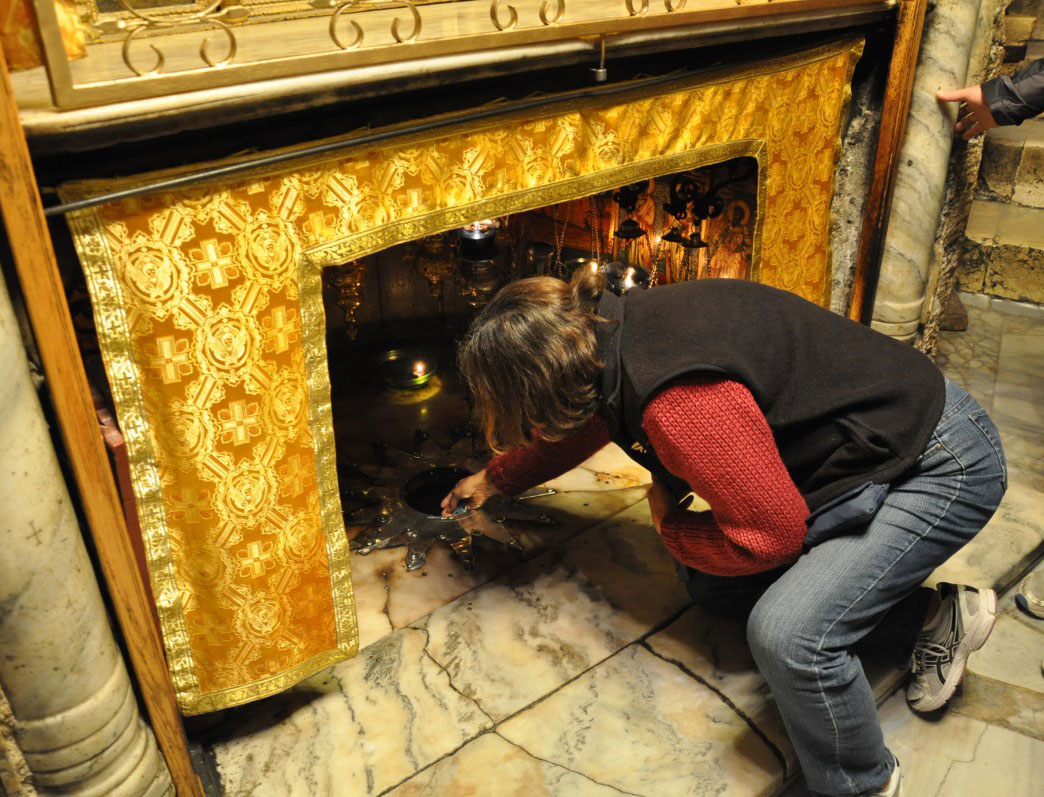
The pilgrims next visited another cave in Bethlehem—the Church of the Nativity, which is built over the cave in which it is believed Christ was born (caves were used as stables in the time of Christ). The site lies in a cave beneath a large church that is currently being renovated for preservation purposes.
Elizabeth “Betty” Schmidt of Nativity of Our Lord Parish in Indianapolis said that seeing the spot where Jesus was born will make the name of her parish take on more meaning.
“It was very beautiful,” she said. “It was exciting to see where Mary delivered and then placed Jesus in the manger. It was thrilling to be there. It says something to your heart to go there and then go back home to Nativity parish.”
Due to walking limitations, her husband Greg was unable to see the underground shrine, but said he was “just happy to be there.
“I was sitting outside looking at the [sign with the] name of Nativity Church, and I thought how wonderful it is that our parish is named after the spot where Christ is born,” he said.
The pilgrims also visited the Milk Grotto, a cave in Bethlehem in which it is believed the Holy Family stopped on their flight to Egypt after the angel Gabriel appeared to Joseph in a dream and warned him of Herod’s desire to kill the Christ child.
 In the city of Christ’s birth, Elizabeth “Lizzy” Maher, a pilgrim from SS. Peter and Paul Cathedral in Indianapolis, celebrated her own birthday. Maher turned 24 today, and was surprised when a cake was brought out after lunch to celebrate.
“It was amazing to celebrate my birthday here,” she said. “The last week has been amazing. I was unsure about coming [on the pilgrimage] because it isn’t like your usual vacation, but it’s been awesome, especially getting time to spend with my family. Traveling with my [mom, dad, sister and retired Father Bob Mazzola, a relative of the family] has been the best gift, more meaningful than a bunch of little gifts.”
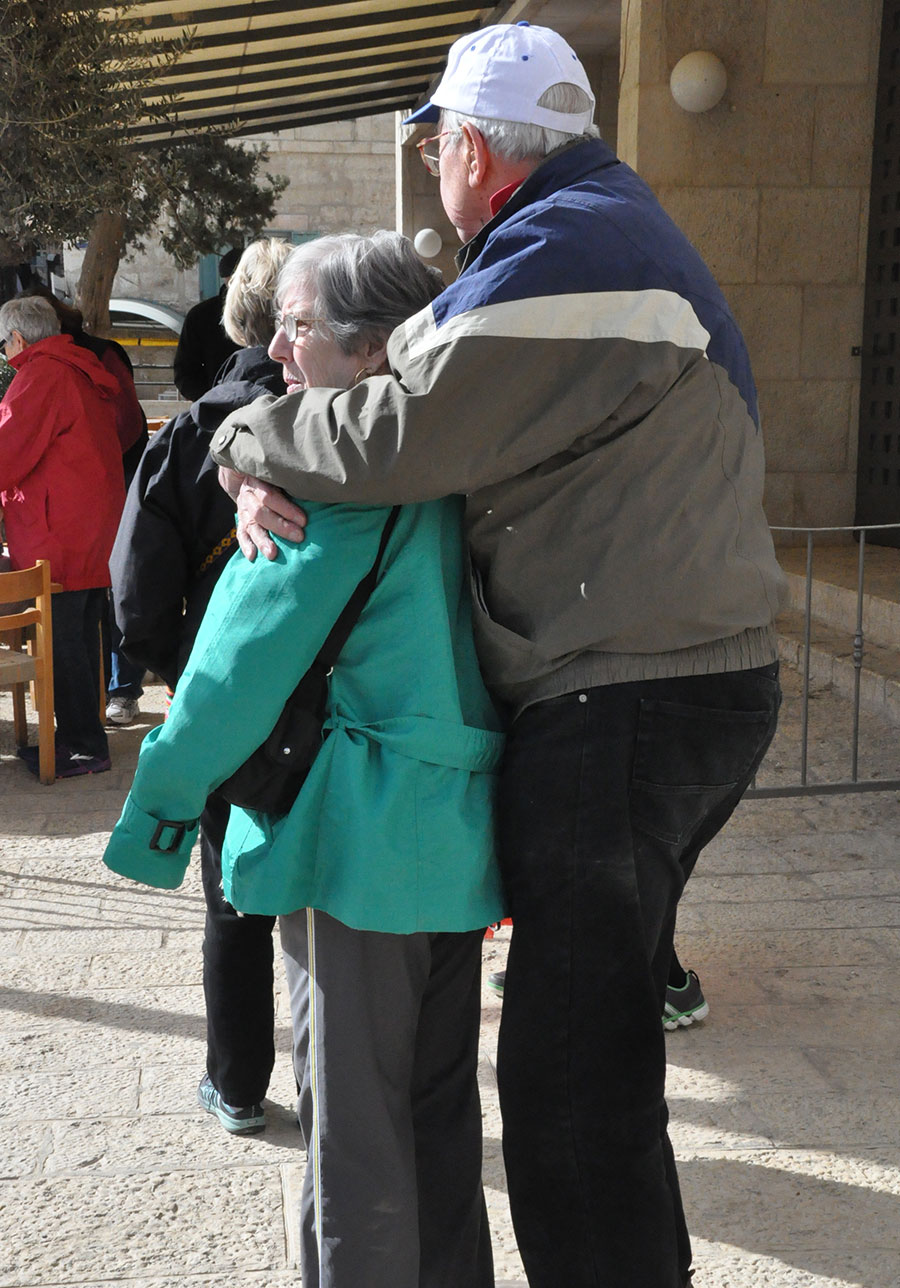
The pilgrimage has also been meaningful for Deitchman, 91, and Eckert, 81. They were married in May of 2012. The two were introduced to each other in October of 2011 by children of each of their prior marriages.
“The last three years have been wonderful,” said Deitchman. “We go to daily Mass together, and we pray together. Those things have been very important to us.”
When asked why they chose to go on the pilgrimage, Bea said, “We figured we better do it now while we still can!”
See a photo gallery from Day Nine of the pilgrimage
Today, the shepherd of the Archdiocese of Indianapolis declared the Good News to his 50 fellow pilgrims on their spiritual journey through the Holy Land. (See a photo gallery from their day)
He did so during a Mass he celebrated in a cave converted into a chapel overlooking a field of Bethlehem. The cave is one of several converted chapels of the Franciscan-run Shepherd’s Field and Grotto.
According to Tony Azraq, the pilgrimage tour guide who also works as an archaeologist, use of the cave dates back at least to the time of Christ, and was likely used by shepherds herding their sheep in the nearby field.
“When Jesus talks about himself as the Good Shepherd, he wasn’t referring to us as sheep in a diminishing way,” said Archbishop Joseph W. Tobin. “As we study God’s word, it became clear that Jesus was referring to how a shepherd controlled his sheep. It was through his voice. The relationship between a shepherd and his sheep is so close.”
The archbishop also said in his homily that Christ calls us “into loving God with all our heart, soul and mind, and loving our neighbor as ourselves.
“That probably sounds a bit foolish, but the reading from I Corinthians reminds us that the weakness of God is stronger than human strength, and the foolishness of God is wiser than human wisdom.
“What we meet here in Bethlehem in a tender and intimate way is the foolishness of God, the weakness of God. It waits for us as a babe wrapped in swaddling clothes lying in a manger.”
Sheila Dropcho of Immaculate Heart of Mary Parish in Indianapolis found herself reflecting on the shepherds during the Mass.
“I think of what Tony said about how young the shepherds were,” she said. “I always pictured them as older men. I just imagined these young boys going home to the parents saying, ‘You won’t believe what just happened!’ ”
 For Bea Eckert and her husband, Richard Deitchman, members of St. Pius X Parish in Indianapolis, the Mass was the highlight of their day.
“I thought it was very intimate having Mass in that little cave,” said Deitchman, who also appreciates the archbishop’s “meaningful, to the point homilies.”
The pilgrims next visited another cave in Bethlehem—the Church of the Nativity, which is built over the cave in which it is believed Christ was born (caves were used as stables in the time of Christ). The site lies in a cave beneath a large church that is currently being renovated for preservation purposes.
Elizabeth “Betty” Schmidt of Nativity of Our Lord Parish in Indianapolis said that seeing the spot where Jesus was born will make the name of her parish take on more meaning.
“It was very beautiful,” she said. “It was exciting to see where Mary delivered and then placed Jesus in the manger. It was thrilling to be there. It says something to your heart to go there and then go back home to Nativity parish.”
Due to walking limitations, her husband Greg was unable to see the underground shrine, but said he was “just happy to be there.
“I was sitting outside looking at the [sign with the] name of Nativity Church, and I thought how wonderful it is that our parish is named after the spot where Christ is born,” he said.
The pilgrims also visited the Milk Grotto, a cave in Bethlehem in which it is believed the Holy Family stopped on their flight to Egypt after the angel Gabriel appeared to Joseph in a dream and warned him of Herod’s desire to kill the Christ child.
 In the city of Christ’s birth, Elizabeth “Lizzy” Maher, a pilgrim from SS. Peter and Paul Cathedral in Indianapolis, celebrated her own birthday. Maher turned 24 today, and was surprised when a cake was brought out after lunch to celebrate.
“It was amazing to celebrate my birthday here,” she said. “The last week has been amazing. I was unsure about coming [on the pilgrimage] because it isn’t like your usual vacation, but it’s been awesome, especially getting time to spend with my family. Traveling with my [mom, dad, sister and retired Father Bob Mazzola, a relative of the family] has been the best gift, more meaningful than a bunch of little gifts.”
The pilgrimage has also been meaningful for Deitchman, 91, and Eckert, 81. They were married in May of 2012. The two were introduced to each other in October of 2011 by children of each of their prior marriages.
“The last three years have been wonderful,” said Deitchman. “We go to daily Mass together, and we pray together. Those things have been very important to us.”
When asked why they chose to go on the pilgrimage, Bea said, “We figured we better do it now while we still can!”
See a photo gallery from Day Nine of the pilgrimage
Subscribe to:
Posts (Atom)